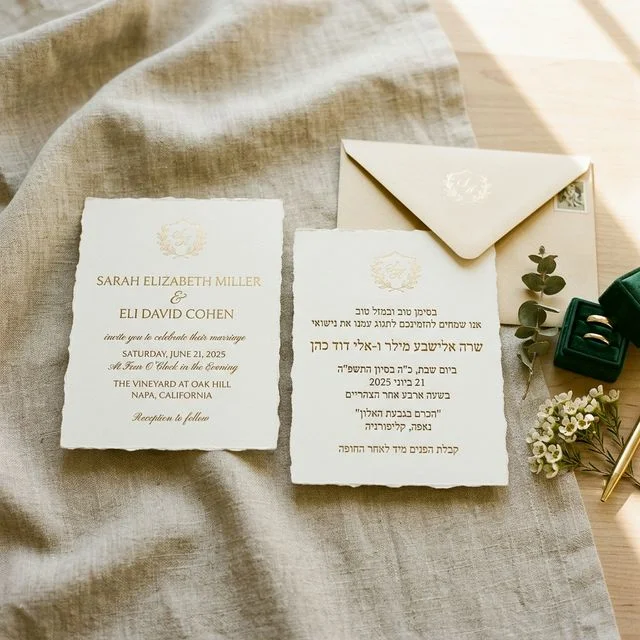
Quick answer: The two things that actually break for international guests are language and reach — an English-only RSVP form, and an invitation sent to an inbox they do not check. Fix both by sending one RSVP link that serves each guest their own language: QuikRSVP translates a single form into any of 70+ languages, with full right-to-left layout for Hebrew, Arabic, Farsi, Urdu, Pashto and Yiddish, all on one link — then deliver it by WhatsApp rather than email outside North America. After that, build the questions they need into the form: arrival dates, dietary needs by culture and observance, and whether they need a letter for a visa application. Here is the full playbook.
Your partner's family is in Brazil. Your best friend lives in Berlin. Half the guest list needs the invitation in Spanish and the other half in English. Someone is flying in from Tel Aviv and someone else from Tokyo. A guest from Nigeria needs a US visa, and you have no idea how to help.
The logistics of an international guest list are real — but they are entirely manageable if you start early and build the right structure. This guide covers the complete picture: specific timeline with exact lead times, a copy-paste visa invitation letter template, country-specific communication channels, cultural dietary considerations, and a priority checklist for the final weeks. The goal is zero surprises on the day itself.
Reading is one thing — trying is another. The phone on the rightbelow is a live, working RSVP: tap the invite exactly like your guests would.
The International Guest Timeline: Exact Lead Times That Actually Work
The standard RSVP timeline — invitations 8 weeks out, deadline 3 weeks before — is built entirely for local guests. It assumes guests drive 45 minutes to reach your venue. When guests need to book international flights, apply for visas, arrange work leave in a different country, and navigate connecting flights across time zones, every milestone needs to shift significantly earlier.
International Guest Pre-Arrival Communication Timeline
- 12 months before: Identify which guests will need visas to enter your wedding country. Contact them individually with a heads-up — some visa processes (US B-2, UK Standard Visitor, Schengen for some nationalities) can take 3-6 months. The earlier you warn them, the better.
- 9-10 months before: Send Save the Dates to international guests — at least one month before domestic Save the Dates. Include: approximate date and city, a note about visa requirements for applicable guests, and an offer to provide a visa invitation letter. Many guests will need this letter to begin their visa application.
- 6-7 months before: Send formal invitations with the RSVP link. This is the prime flight-booking window — 5-7 months before departure typically captures the best fares. Include all hotel block details, nearest airport, and transportation logistics in the same mailing or email.
- 4-5 months before: RSVP deadline for international guests. This gives them time to book affordable flights while still confirming before your domestic RSVP deadline. Offer two deadlines if needed: "International guests: please respond by [date]. Domestic guests: please respond by [date]."
- 2-3 months before: Send confirmed guests their visa invitation letter if needed (see template below). Send hotel block booking reminders with the link and code. Confirm room block quantities with the hotel based on response data.
- 4-6 weeks before: Send detailed travel logistics to all confirmed international guests: airport, hotel, shuttle schedule, weather and dress code, power outlet information, emergency contacts.
- 1 week before: Send a WhatsApp broadcast to all confirmed international guests with the final day-of itinerary: exact shuttle departure time, ceremony start time, and who to contact on the day if they have questions.
- Day before: WhatsApp message to international guests checking in: "We can't wait to see you tomorrow! Shuttle departs the hotel lobby at [time]. Room for questions — text [name] at [number]."
Why the early RSVP deadline benefits your guests: International flights booked 4-6 months out are consistently 30-50% cheaper than flights booked last-minute. When you set an early RSVP deadline, you are not inconveniencing guests — you are giving them the advance notice they need to book affordable travel. Frame the early deadline this way in your invitation: "We've set an early RSVP deadline so you have time to book flights at the best prices."
Multilingual RSVP Forms: How Auto-Translation Actually Works
If your guest list includes people who speak different languages, sending everyone the same English-only form creates friction. Some guests will struggle with the wording, misunderstand questions, or simply feel less welcome than they should.
There are three approaches to multilingual RSVPs, and they vary dramatically in effort and effectiveness.
Approach 1: Create Separate Forms Per Language
Build one form in English, another in Spanish, another in Portuguese. Send the right link to the right group. This works but creates a management headache — you now have three dashboards, three exports, and three sets of data to merge.
Approach 2: Side-by-Side Languages on One Form
Display both languages on the same invitation. This works for printed materials but gets cluttered on digital forms, especially with more than two languages.
Approach 3: Auto-Detecting Multilingual Forms (Recommended)
This is the modern approach. You build one form, translate it into as many languages as you need, and share a single link. When a guest opens the form, it detects their browser's language setting and automatically serves the form in their language. A guest in Brazil sees Portuguese. A guest in Germany sees German. A guest in the US sees English.
If the auto-detection is wrong (say, a Brazilian using an English-language browser), the guest can manually switch languages from a dropdown on the form.
With QuikRSVP, here's how this works in practice:
- Build your form in your primary language (English, for example)
- Click "Translate" and select the additional languages you need
- The AI translator converts every element — event details, questions, buttons, confirmation messages, and even custom field labels
- Review the translations (you can edit any phrasing that doesn't feel right)
- Share one link. Every guest sees their own language.
All responses feed into a single dashboard regardless of language. Your guest list doesn't get fragmented across multiple forms.
One Form, 70+ Languages
Auto-detecting multilingual RSVPs with 70+ languages. Every guest sees the form in their language. All responses in one dashboard.
Language-Specific RSVP Etiquette: What to Expect from Different Cultures
RSVP culture varies wildly across countries and regions. Understanding these differences helps you set realistic expectations and avoid misinterpreting responses.
| Culture / Region | RSVP Expectations | What to Plan For |
|---|---|---|
| United States / Canada | Formal RSVP expected. Most guests respond by the deadline if reminded. | Plan for 5-10% no-shows among confirmed guests. |
| Israel | RSVPs are often informal. Guests may confirm via WhatsApp message or phone call rather than a form. Many wait until the last minute to decide. | Send WhatsApp reminders. Expect 15-20% more or fewer guests than confirmed. Israeli weddings typically overplan on food. |
| Latin America | Family-oriented culture. A guest who RSVPs for two may arrive with four (children, elderly parents). RSVPs may come late. | Explicitly state who is invited by name. Add a buffer of 10-15% extra meals. Use WhatsApp for all communication. |
| India | Formal RSVPs are less common culturally. Guests may confirm verbally to family members rather than through a form. Large families may assume extended family is included. | Confirm attendance through family intermediaries. Be very explicit about guest count limits. Plan for 10-20% more guests. |
| Western Europe | Generally punctual with RSVPs. German and Scandinavian guests tend to respond early and accurately. Southern European guests may be more flexible with timing. | Expect reliable headcounts from Northern European guests. Add a small buffer for Southern European guests. |
| East Asia | RSVP compliance is high. Japanese and Korean guests are likely to respond promptly and attend as confirmed. Gift-giving expectations may differ. | Reliable headcounts. Provide clear cultural context for Western wedding traditions that may be unfamiliar. |
| Middle East / North Africa | Verbal confirmation is common. WhatsApp is the primary channel. Hospitality culture means guests may bring family members as a sign of respect. | Use WhatsApp for invitations and follow-ups. Clearly communicate guest limits with warmth. Over-plan catering by 10%. |
The takeaway: don't treat a lack of formal RSVP response as rudeness. In many cultures, the concept of filling out a form to confirm attendance is simply not the norm. Meet your guests where they are — if their culture communicates through WhatsApp, send invitations through WhatsApp.
Visa Logistics: What You Can Do, What You Can't, and the Letter Template
If guests need visas to enter your wedding country, this is the single most time-sensitive logistics item on your list. A guest who starts the visa process too late simply will not make it — and you will not know until it is too late to do anything about it.
You cannot file a visa application on a guest's behalf. What you can do is provide a formal letter of invitation, which is required or strongly helpful for tourist visa applications in many countries (US B-2, UK Standard Visitor, Schengen, Canada, Australia). The letter needs to come from a host residing in the destination country — typically one of the couple, a family member, or a contact who lives there.
Visa Processing Times by Country (as of 2026)
| Destination Country | Visa Type | Typical Processing Time | Start Process By |
|---|---|---|---|
| United States | B-2 Tourist Visa | 2-6 months (interview required) | 6 months before the wedding |
| United Kingdom | Standard Visitor Visa | 3-8 weeks (online) | 3 months before the wedding |
| Schengen Area (EU) | Schengen Short-Stay Visa | 2-4 weeks; apply no more than 6 months before | 3-4 months before the wedding |
| Canada | Temporary Resident Visa | 2-8 weeks (varies by nationality) | 3-4 months before the wedding |
| Australia | Visitor Visa (subclass 600) | 3-6 weeks for most; longer for some nationalities | 3-4 months before the wedding |
| Israel | Visa on arrival for many; others require advance visa | Varies significantly by passport | Check Israeli embassy for specific nationality |
Copy-Paste Visa Invitation Letter Template
This letter template follows the format most commonly accepted by consulates for tourist visa applications. Replace all bracketed text with your actual details. Have it printed on plain paper with a handwritten signature, or as a PDF if submitting electronically.
Visa Invitation Letter Template
[Your Full Name]
[Your Address, City, State/Province, Postal Code, Country]
[Your Phone Number]
[Your Email Address]
[Date]
To the Consulate General of [Country],
I am writing to invite [Guest's Full Name], born [Date of Birth], a citizen of [Guest's Country], holding passport number [Passport Number], to attend my wedding as a personal guest.
[Bride's Full Name] and [Groom's Full Name] will be married on [Wedding Date] at [Venue Name], [Venue Address, City, Country]. [Guest's Name] is [relationship — e.g., my aunt / my close friend of 15 years / my cousin] and their presence at our wedding is deeply meaningful to us.
[Guest's Name] will be visiting [Destination Country] from approximately [Arrival Date] to [Departure Date], a total of [X] days. They plan to stay at [Hotel Name or your address]. I confirm that they will be financially responsible for their own travel and accommodation expenses during this visit.
I am a [citizen/permanent resident] of [your country], and I am happy to be contacted for any additional information or verification.
Sincerely,
[Your Signature]
[Your Printed Name]
[Your National ID or Passport Number, if required by the specific consulate]
Important: Each Consulate Has Different Requirements
The template above covers the standard elements most consulates request. However, specific requirements vary. The US B-2 interview typically focuses on ties to the home country and ability to finance the trip — the invitation letter supports but does not replace those factors. The UK and Schengen consulates often ask for evidence of accommodation booking and financial means in addition to an invitation letter. Always check the specific consulate's website for the applicant's nationality before sending the letter.
What to Include in Your RSVP Form for International Guests
Add these custom fields specifically for guests who will be traveling internationally. QuikRSVP's custom fields support all of these as text, dropdown, or yes/no questions:
- "Do you need a visa invitation letter?" (Yes / No / Not sure) — Ask proactively. Many guests will not know they need one until they research it, and by then it may be close to the deadline.
- "What is your country of citizenship?" — This lets you identify which guests may need visa assistance and reach out with specific guidance.
- "What is your planned arrival date?" — Useful for airport pickup coordination, welcome event planning, and hotel block management.
- "Do you need hotel or transportation recommendations?" — Helps you gauge demand for room blocks and shuttle services before committing to a hotel room block size.
- "Will you need a shuttle from the hotel to the venue?" — Allows accurate shuttle capacity planning without over-ordering.
Communicating Through the Right Channels
Email is not the universal communication method. Depending on where your guests live, they may rarely check email but respond to WhatsApp within minutes. Here's a channel guide:
- WhatsApp: The default messaging app across Latin America, Europe, the Middle East, India, and Africa. If you have guests from any of these regions, WhatsApp should be your primary communication channel — not a backup.
- Email: Still dominant in the US, Canada, and corporate/professional contexts. Good for formal communications and attaching documents (itineraries, maps, visa letters).
- WeChat: Essential for guests in mainland China. If you have Chinese guests, ask a Chinese-speaking friend to help send invitations through WeChat.
- Line: The primary messaging app in Japan, Taiwan, and Thailand.
- SMS/Text: A fallback for guests who don't use messaging apps. Less reliable internationally due to carrier fees.
The practical solution: Use a combination. Send the RSVP link via WhatsApp to international guests (with QuikRSVP's bulk WhatsApp campaign, you can message all of them at once — personalized with names) and via email to domestic guests. For reminder campaigns, use the same split. This way, every guest receives the invitation through their preferred channel.
WhatsApp Message Templates for International Guests
Initial Invitation (WhatsApp)
"Hi [Name]! We're so excited to share that we're getting married on [Date] in [City]! We would love to have you there. Here's the RSVP link — it's available in [Language] too: [link]. Please let us know by [Deadline] so you have time to book flights at a good price. We can help with visa letters or hotel recommendations — just ask!"
Reminder for Non-Responders (WhatsApp)
"Hi [Name]! Just a gentle reminder — our RSVP deadline is [Date]. We totally understand if international travel isn't possible, but we'd love to know either way so we can finalize plans. RSVP here: [link]. No pressure!"
Travel Details for Confirmed Guests (WhatsApp)
"Hi [Name]! So happy you're coming! Here are the details you'll need: Fly into [Airport]. We've reserved rooms at [Hotel] — booking link: [link]. Shuttle from the hotel to the venue departs at [Time]. Weather will be [description], so dress [suggestion]. Let me know if you need anything!"
Formal Email Template for International Guests
Subject: You're Invited — [Couple Names] Wedding in [City], [Date]
Hi [Name],
We're getting married on [Date] in [City], and we would be thrilled to celebrate with you!
Key details for international guests:
- Nearest airport: [Airport name and code]
- Hotel block: [Hotel name] — reserved rate available through [link]
- Shuttle service: Provided from the hotel to the venue
- Visa information: [Country]-passport holders may need a tourist visa — we're happy to provide an invitation letter
- RSVP deadline: [Date] (to give you time to book affordable flights)
RSVP here (available in multiple languages): [link]
Questions? Reply to this email or WhatsApp us at [number].
We can't wait to see you!
Love, [Couple Names]
How to Handle Different Meal Expectations Across Cultures
Dietary needs at a multicultural wedding go far beyond "vegetarian or not." Different cultures have deeply held food traditions, religious requirements, and default expectations that your caterer needs to know about.
Common Cultural Dietary Considerations
- Kosher (Jewish guests): Meat and dairy cannot be served together. Pork and shellfish are prohibited. Strictly kosher guests may only eat food prepared in a kosher-certified kitchen. Ask whether they need a fully kosher meal or are comfortable with "kosher-style" (no pork/shellfish but not certified).
- Halal (Muslim guests): Pork and alcohol are prohibited. Meat must be halal-slaughtered. Many Muslim guests are comfortable at events where alcohol is served to others but will need a halal protein option. Ask your caterer if they can source halal meat.
- Vegetarian by default (Indian guests): A significant percentage of Indian guests may be vegetarian — not by choice but by cultural and religious tradition. Don't assume "one vegetarian option" is enough if you have a large Indian contingent. Consider making vegetarian dishes a prominent part of the main menu, not a side option.
- No-alcohol expectations: Guests from conservative religious backgrounds (some Muslim, Mormon, evangelical Christian, and Orthodox Jewish communities) may be uncomfortable at events where alcohol is the centerpiece. Ensure there are appealing non-alcoholic beverages readily available — not just water and soda.
- Spice tolerance: This sounds minor but matters for large groups. Guests from South Asian, Latin American, and Southeast Asian backgrounds may find standard American/European catering bland. Guests from Northern European or Japanese backgrounds may find bold spices overwhelming. A varied menu with dishes at different flavor levels serves everyone.
How to Collect This Information
Your RSVP form's dietary field should be open-ended, not a dropdown. Instead of forcing guests to choose from "Vegetarian / Vegan / Gluten-Free," use a text field: "Please share any dietary restrictions, allergies, or food preferences (e.g., kosher, halal, vegetarian, nut allergy)."
This lets guests describe their needs in their own words, which gives your caterer more useful information than a checkbox ever could.
Currency and Gift Considerations for International Guests
Gift registries and cash funds create unexpected complications for international guests. Venmo doesn't work outside the US. Zelle is US-only. Many registry platforms charge international shipping rates that exceed the gift value. And some cultures have different gifting norms entirely.
Options That Work Across Borders
| Gift Option | Works for International Guests? | Notes |
|---|---|---|
| PayPal cash fund | Yes — available in 200+ countries | Auto-converts currencies. Small fee (2.9% + fixed). Most universally accessible option. |
| Honeymoon fund (e.g., Honeyfund) | Mostly — some platforms support PayPal | Guests "buy" experiences (dinner, excursion) rather than giving raw cash. Feels more personal. |
| Venmo / Zelle | No — US only | Fine for domestic guests, useless for international. |
| Physical registry (Amazon, Crate & Barrel) | Difficult — shipping costs and availability vary by country | International guests may pay 2x the gift value in shipping. |
| Cash/check at the wedding | Yes — traditional in many cultures | Common in Israeli, Chinese, Korean, and many European wedding traditions. No platform needed. |
| "No gifts, your presence is enough" | Yes — universally understood | Removes all pressure. Especially appreciated by guests who traveled far. |
Cultural note: In many cultures, cash gifts at the wedding are the norm — not an alternative to a registry. Israeli, Chinese, Korean, and many Eastern European guests expect to bring cash in an envelope. If your guest list includes these cultures, having a card box at the reception is respectful and expected.
Providing Travel and Accommodation Information
International guests need significantly more logistical support than local guests. Don't make them hunt for information — provide it proactively, ideally in the same communication as your RSVP link.
A wedding website is the practical home for all of it — one link carrying the airport codes, hotel blocks, transfer times and dress code that overseas guests re-check several times before they fly, rather than a message thread they have to scroll back through. QuikRSVP's wedding website builder translates the whole site automatically, so a guest who filled in the RSVP in Hebrew or French reads the travel instructions in that language too.
Essential Travel Information to Share
- Nearest airport with code: "LAX — Los Angeles International Airport" (international guests may not know abbreviations)
- Hotel block details: List 2-3 hotels at different price points with direct booking links and group rate codes. Include distance from venue.
- Ground transportation: "We'll provide a shuttle from [Hotel] to the venue at 3:00 PM. Uber/Lyft are available. Taxi from LAX to the hotel is approximately $50."
- Visa guidance: "Guests from [countries] will need a US tourist visa (B-2). Start the application at least 6 months before the wedding, because interview waits can be long. We're happy to provide an invitation letter — just let us know on the RSVP form."
- Weather and dress code: "June in Los Angeles: sunny, 75F / 24C. Garden formal attire. The ceremony is outdoors on grass — flat shoes recommended."
- Power and connectivity: "US outlets are 110V, Type A/B plugs. Free WiFi available at the venue."
- Emergency contact: Provide a local phone number (not just email) for day-of emergencies.
Handling "Maybe" Responses from International Guests
International travel is expensive and complicated. You'll get more uncertain responses from overseas guests than from local ones, and that's completely normal. A guest weighing a $1,500 flight plus hotel plus time off work is making a bigger commitment than a guest driving 45 minutes.
Here's how to manage uncertainty without creating awkwardness:
- Set an early but firm deadline. Your RSVP deadline for international guests should be 4-5 months before the wedding. Frame it as helpful: "We set the deadline early so you can book flights at the best prices."
- Follow up warmly. A message like "We totally understand if it's not possible this year — no pressure either way. We just need to give our venue final numbers by [date]" removes guilt and gets you an answer.
- Plan for a 15-20% "maybe-to-no" conversion. If you have 20 international guests who said "maybe," assume 3-4 of them will ultimately decline. Factor this into your caterer buffer.
- Don't hold seats indefinitely. If you haven't heard back by the deadline, count them as a "no" for planning purposes. You can always add them back if they confirm late.
Time Zones in Communication: The Practical Rules
When your RSVP deadline says "March 31," a guest in Sydney is 18 hours ahead of the US West Coast. A guest in London is 8 hours ahead. A guest in Tel Aviv is 10 hours ahead. If you write "please respond by March 31" without a time zone, you will get replies timestamped April 1 from guests in Asia and Australia who responded perfectly on time by their calendar but technically "missed" your deadline.
How to Communicate Deadlines Across Time Zones
- Always include the time zone in writing. "RSVP by March 31, 2026, at 11:59 PM Eastern Time (EDT / UTC-4)" is unambiguous. Without the time zone, the deadline is genuinely unclear for international guests.
- Add a converted time for your main international region. If most of your international guests are in Israel, add: "That's 6:59 AM on April 1, Israel time." By March 31 both countries are on summer time (US Eastern: EDT, UTC-4; Israel: IDT, UTC+3), so the gap is 7 hours. A single conversion eliminates confusion for the bulk of your overseas guests.
- Give extra buffer time. Set your RSVP form to close 2-3 days after your stated deadline. This absorbs legitimate time-zone confusion and last-minute submissions from guests who got stuck traveling.
- Use an auto-closing RSVP form. Platforms like QuikRSVP close the form at the time you set, regardless of what time zone a guest is in. The form simply closes — no ambiguity, no exceptions to manage manually.
Scheduling Follow-Up Messages Across Time Zones
When you send a WhatsApp reminder to your international guests, think about what time it is for them. A reminder sent at 10 AM in Los Angeles in winter (Pacific Standard Time, UTC-8) arrives at 6 PM in London, 8 PM in Tel Aviv, and 3 AM the next day in Tokyo. Messages arriving at inconvenient hours may be dismissed or forgotten. For bulk WhatsApp campaigns, aim to send during the recipient's mid-morning (9-11 AM local time). If your guest list spans too many time zones for this to be practical, sending during your own mid-morning is a reasonable default — just be aware that some international guests will receive it at off-hours.
Day-of Coordination for International Guests
Your international guests may be dealing with jetlag, unfamiliar surroundings, and language barriers on the wedding day itself. A few small touches go a long way:
- Welcome bags at the hotel: Snacks, bottled water, a local map, an itinerary card, and a handwritten note. This costs $10-15 per room and makes a lasting impression.
- A WhatsApp broadcast for day-of updates: "Ceremony starts in 1 hour! Shuttle departs from the hotel lobby at 3:00 PM. See you there!" This is far more effective than email for real-time communication.
- Bilingual signage at the venue: If a significant portion of your guests speak another language, print key signs (restrooms, ceremony area, reception, bar) in both languages.
- A designated "international guest liaison": Ask a bilingual friend or family member to be the go-to person for international guests who have questions or feel lost. This takes the burden off you on your wedding day.
International Guest Priority Checklist
Use this checklist as your master reference. Items are organized by when they need to be completed. For a wedding with international guests, start working through this list the moment you set the date.
12+ Months Before
- Identify all guests who will need visas to attend
- Contact visa-required guests individually about processing timelines
- Determine which of you (or which local family member) will write visa invitation letters
- Build your multilingual RSVP form — include visa letter request, citizenship, arrival date, and shuttle/hotel fields
9-10 Months Before
- Send international Save the Dates (before domestic ones)
- Include visa guidance and offer to provide invitation letters
- Share nearest airport, general accommodation area, and approximate trip cost context
- Confirm your hotel room block size based on estimated international attendance
6-7 Months Before
- Send formal invitations with RSVP link (include all logistics in the same communication)
- Set international RSVP deadline 4-5 months before the wedding
- Send WhatsApp invitations to guests in WhatsApp-dominant regions (Latin America, Israel, Middle East, Europe)
- Include complete hotel block info, booking link and group code, and shuttle details
After RSVP Deadline
- Send visa invitation letters to every guest who requested one
- Send hotel room block reminder with deadline to confirmed international guests
- Compile dietary restrictions from international guests and flag for caterer
- Confirm shuttle capacity against confirmed arrival dates
- Build your international guest seating assignments, keeping language groups and family units together where possible
2-4 Weeks Before
- Send detailed day-of logistics document to all confirmed international guests: airport, hotel check-in, shuttle schedule, ceremony timing, dress code, weather, venue address with Google Maps link, emergency contact number
- Prepare welcome bags for hotel delivery (water, snacks, itinerary, local map, outlet adapter if different country)
- Confirm bilingual signage at venue for relevant language groups
- Designate your international guest liaison — a bilingual friend or family member who will be the go-to person for guests who feel lost
- Set up a WhatsApp group for international guests (or a one-way broadcast list) for day-of updates
Day Before and Day Of
- Deliver welcome bags to hotel rooms (or arrange hotel concierge to do so)
- Send day-before WhatsApp message with shuttle time, starting time, and contact number
- Have your international liaison available from guest check-in time onward
- Have a physical card box at the reception for guests bringing cash envelopes (common in Israeli, Chinese, Latin American, and Eastern European traditions)
Common Mistakes When Managing International Guests
Avoid These Pitfalls
- Assuming English-proficient guests are comfortable with formal RSVP English. Someone who speaks conversational English for work may struggle with "kindly RSVP by" or "regrets only." A form in their native language removes all ambiguity and gets you better data.
- Not mentioning visa requirements in the Save the Date. If you wait until the formal invitation, guests from some countries may have already missed the window to apply in time. The US B-2 visa requires an interview appointment, which can be booked out 2-4 months in advance in some cities.
- Choosing a Friday evening ceremony without accounting for travel days. International guests traveling from Europe or Asia to the US lose two work days minimum — travel Thursday, recover Monday. A Saturday afternoon ceremony gives guests the option to fly Thursday evening and arrive Friday morning with time to rest.
- Scheduling key pre-wedding events on arrival day. A guest flying from Tokyo to New York is landing after 13-14 hours in the air and up to 14 hours of jet lag. A welcome dinner or rehearsal on that same evening is asking a lot. Schedule anything optional the day after arrival.
- Offering only US-centric payment options for the hotel or registry. Hotel room block booking forms that only accept US-issued cards leave international guests scrambling for workarounds. Confirm with your hotel that international credit cards are accepted and communicate this clearly.
- Using email as the only communication channel. For guests in Israel, Brazil, Mexico, France, Germany, India, or any Middle Eastern country, WhatsApp is the primary communication app — not email. Your formal invitation email may land in a spam folder and sit unread for weeks. Follow up everything important via WhatsApp for these guests.
- Setting one RSVP deadline for everyone. Give international guests an earlier deadline — ideally 4-5 months before the wedding. Domestic guests can respond closer to the event. Two deadlines are easier to manage than a wave of late international responses that arrive after you've started planning.
Manage International Guests Effortlessly
Multilingual RSVPs with auto-translation, WhatsApp invitations, custom fields for travel details, and real-time tracking — all in one tool.
Frequently Asked Questions
How do I find out which guests need a visa for my wedding country?
The most reliable source is the official government website of your wedding destination's immigration authority. For the US, that's travel.state.gov. For the UK, it's gov.uk/check-uk-visa. For Schengen countries, each EU member state's embassy publishes visa requirements by nationality. As a starting point: guests from India, Nigeria, China, Russia, and most African countries typically need advance visas for the US, UK, and Schengen. Guests from Israel, most EU countries, and Japan typically do not for many destinations. When in doubt, ask the guest to check their own government's travel advisory site.
How many languages can I translate my RSVP form into?
QuikRSVP supports 70+ languages through AI-powered translation. The builder interface itself is available in English, Spanish, French, German, Portuguese, Hebrew, and Arabic. AI translation covers any of the additional 70+ languages for the form that guests see. The free tier includes 1 translation language; Event Pro ($45 one-time per form) unlocks unlimited translations. The most commonly needed languages for international wedding RSVPs are Spanish, Portuguese, Hebrew, Arabic, French, German, and Mandarin.
Will international guests need to select their language manually?
No. The form auto-detects the guest's browser language and serves the form in that language automatically — including correct RTL layout for Hebrew and Arabic. If the auto-detection is wrong (for instance, a Brazilian guest using an English-language phone), the form shows a language switcher dropdown so the guest can select their preferred language manually.
How do I send WhatsApp invitations to guests in different countries?
QuikRSVP's bulk WhatsApp campaign feature sends personalized messages to your entire guest list at once, regardless of country. You need each guest's phone number with the correct country code (e.g., +972 for Israel, +55 for Brazil, +44 for UK). Each message includes the guest's name and a direct RSVP link. Note: for US phone numbers, WhatsApp campaigns automatically fall back to SMS because WhatsApp requires Meta template approval for bulk business messages, and US users have lower WhatsApp adoption rates than international users.
Should I create separate RSVP forms for different language groups?
No. Creating separate forms — one in English, one in Spanish, one in Hebrew — creates a management problem: three dashboards, three exports, three headcounts to reconcile. When a guest uses the wrong link, their response ends up in the wrong form. Use a single auto-translating form with one dashboard. Every response flows into the same tracking view regardless of language. This is simpler to manage and produces a single clean data export.
How do I handle guests who normally RSVP verbally?
In Israeli, Latin American, Indian, and Middle Eastern traditions, formal digital RSVPs are often not the norm. The approach that works: send a personal WhatsApp message alongside the RSVP link — "I'm sending you this link so it's easy for you — just tap yes or no, it takes 30 seconds." The personal context makes the form feel like a courtesy rather than a bureaucratic requirement. For guests who still confirm verbally (phone call, in-person), enter their response manually in your dashboard. Most platforms including QuikRSVP support manual response entry.
Frequently Asked Questions: International Wedding Guests
WhatsApp is the dominant messaging channel in most non-US countries (Mexico, Brazil, Israel, Spain, Portugal, France, Germany, Arabic-speaking countries). In our own data, 60.6% of WhatsApp invitations are read against 40.7% of emails opened — and the email figure is undercounted, since it depends on images loading. Use a platform that supports WhatsApp bulk campaigns — QuikRSVP lets you upload contacts and send personalized WhatsApp invitations with an RSVP link in one go.
Yes. With a multilingual RSVP form, guests see the form in their preferred language. QuikRSVP translates your form into 70+ languages using AI — guests see a language selector and toggle freely. All responses appear in your dashboard in the source language.
A visa invitation letter should include: your full name and address, your relationship to the guest, the guest's full name and nationality, the wedding date and location, a statement that you will cover accommodation (if true) or that the guest is self-funding, and your signature. Use formal language. Some embassies have specific templates — check the requirements for the guest's destination country.
Contact guests who will need visas individually about 12 months before the wedding, then send save-the-dates to international guests 9-10 months before. Guests from countries with complex visa processes (US B-2, UK Standard Visitor, Schengen for some nationalities) may need 3-6 months for visa approval alone. Send formal invitations 6-7 months before the wedding.
Create a wedding website with a dedicated Travel & Accommodations page. List nearby hotels with direct booking links, include directions from major airports, and add local tips. QuikRSVP's wedding website builder includes this page by default. Share the website URL in your invitation and WhatsApp campaign.
Segment your guest list by country and language. Send country-specific campaigns (WhatsApp for most international guests, email for US contacts). If guests speak different languages, use a bilingual or multilingual RSVP form. Set an earlier RSVP deadline for international guests to account for travel planning time.
Planning a Multicultural Wedding?
Auto-translating RSVPs, WhatsApp invitations, and a single dashboard for guests from every corner of the world.